Boat Food: Cast Iron Skillet Pizza

Its Friday. We’re on the mooring in Buzzards Bay and its cold and windy. So why not bake a pizza?

Andante’s original-equipment propane-fired oven is low-tech (no thermostat) and poorly insulated. But it gets the job done under some crazy conditions and still cooks better than our fancy oven in the dirt house. Go figure.
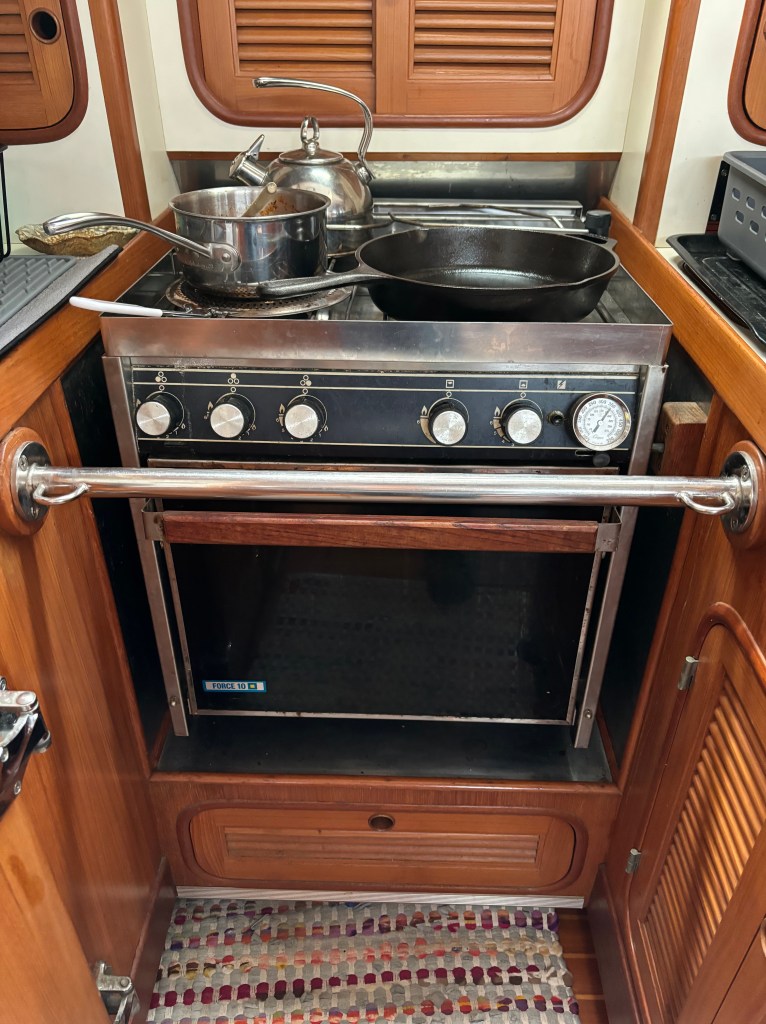
1988 Force 10 3-burner propane stove.

Step 1: Make the dough. I did this earlier this afternoon using a recipe that has worked for me for many years. It is arguably better if you swap half the regular flour for 00 pizza flour. But I don’t have that. And it will still be great.

I do have: 3 cups flour, 2 teaspoons salt, 1 teaspoon sugar. 1 packet (2.25 teaspoons) yeast. 1 cup water. 1 bottle red wine. Mix it all together (except the wine) as best you can in a large bowl. When dough-like, knead until smooth, keeping it in the bowl if possible to avoid a mess. Form into a happy ball, coat in olive oil, and place back in the bowl under a towel to rise for an hour or two (or three, if its cold like it is here today.) Then divide into two balls and (if you are me) freeze one for later.

Dough!

Step 2: Make some sauce. I made a simple marinara with garlic sauteed in olive oil, basil, oregano, red pepper, and a small can of diced tomatoes and cooked it down for about 30 minutes.
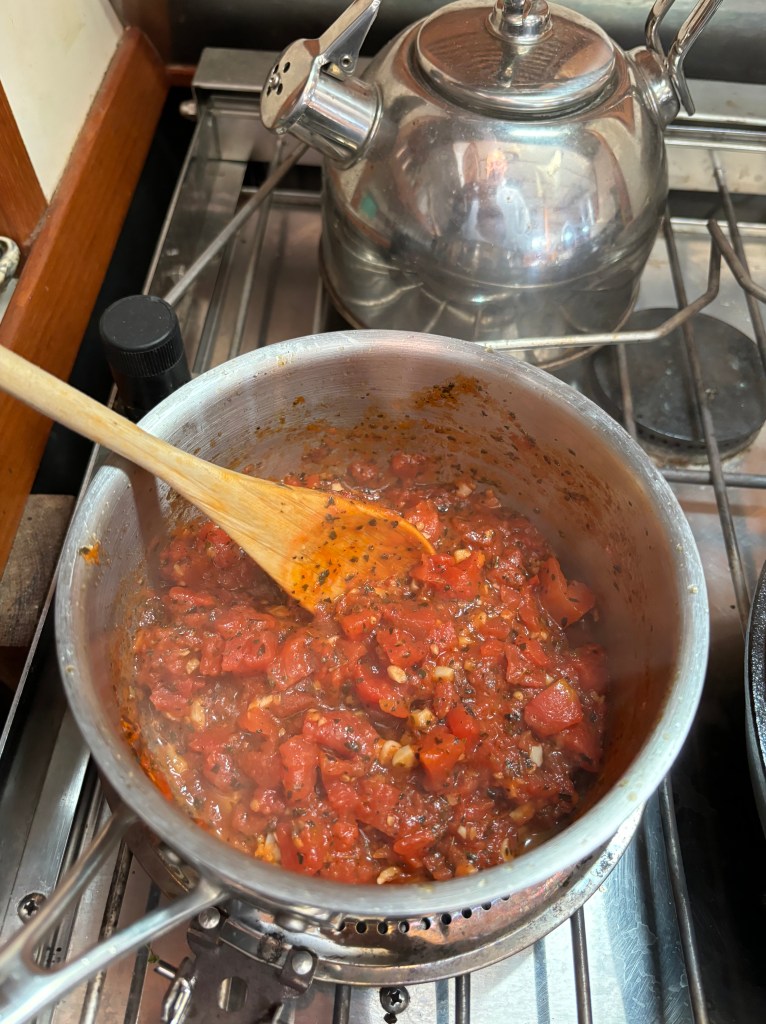
Simple marinara sauce. Could also use basil pesto. Or garlic, oil and anchovy paste.

Step 3: Preheat the oven. It should be as hot as you can get it. On Andante that is just over 400 deg F and it takes a solid 30 minutes to reach that temperature. In a dirt house you could easily reach 500 F. Whatever. You’ll be watching closely to see when your pizza is done and a hotter oven will just get you there faster.

Step 4: When the oven is almost hot, preheat your cast iron skillet on medium-high heat on the stovetop. For 5-6 minutes. Until really hot. Turn off the stove. Swizzle a generous amount of olive oil in the pan and maybe use a bit of paper towel to wipe the oil around and be sure it coats the whole thing.

HOT!! Note: This is before I added a couple of tablespoons of oil to the pan. There was an actual puddle of oil in the pan when I added the dough in the next step.

Step 5: Quickly, form your happy dough ball into an approximate pizza shape by pulling and stretching as needed and then plop it in the hot pan. Carefully, without searing your fingertips, press around the edges so the dough mostly fills the pan. It will probably be making attractive sizzling sounds at this point.

Don’t overthink this. A somewhat uneven disc of dough will taste exactly as good as a perfect circle. Just be careful not to burn your fingers on the pan.

Step 6: Toppings. With no delay, spread your sauce and whatever pizza toppings you prefer on the dough. I used mozzarella, feta, romano and parmesan cheeses. No animals died for my pizza. But several were thoroughly squeezed.

Step 7: Bake that thing. Carefully put the freaky hot pan in the oven and let it cook until the top is brown and bubbly. That should take between 10-15 minutes.

I keep a pizza stone in Andante’s oven. I’m not sure it helps but it looks cool.

It may not be Food & Wine attractive but the end result is perfectly acceptable after that bottle of wine. And the crust is nicely browned and crispy. Who needs anything else on a Friday night?
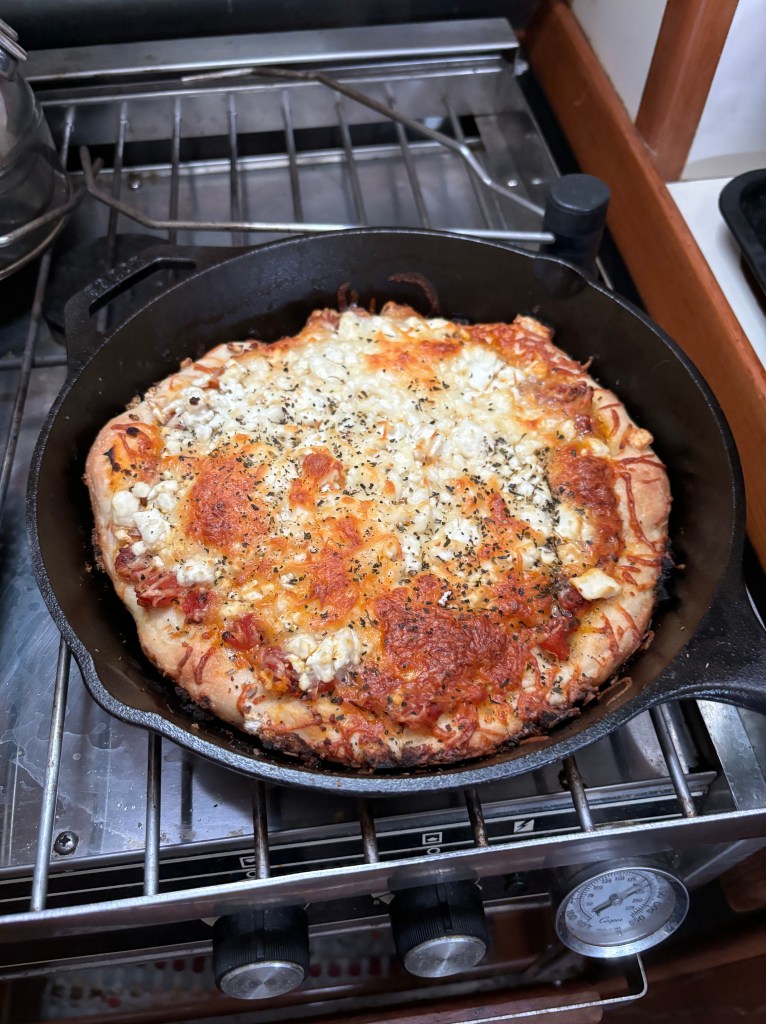
Except maybe another bottle of wine.

Enjoy your weekend.

Winter 2023/2024 Recap

It’s not you. Its us.

Six months have passed and, at least according to this blog, nothing has happened. This is not the first time we’ve dropped the ball and left our loyal readers hanging. And it will not be the last. But hopefully, with this post, we will bring you up-to-date with our activities of the past half-year.

Per Paula’s excellent travelogue last November, we arrived at Bock Marine in Beaufort, NC and settled in for a quiet winter on the hard. The plan was for me (Dave) to train/fly/drive from Cape Cod to NC to live and work on Andante for about a week each month. That actually happened.

The train approach was novel and fun and had potential. But it was hopelessly long with the one-way trip exceeding 28 hours including a 4-hour drive from Norfolk where the train actually terminated. At 2 AM.

Flying was relatively quick but placed limitations on what could be carried back and forth (ever try flying with solar panels, an outboard motor and your shop vac?). Flying would have been prohibitively expensive if we didn’t have lots of airline miles to burn. But we did, so I used that method of transport twice.

In the end, driving (18 hours +/-) just wasn’t that bad and provided the lowest total cost (no rental car) and maximum flexibility in both schedule and payload.

On the first first few trips I enjoyed the hospitality and central heating of my wonderful in-laws. Later in the spring I made use of ample shore-power to stay aboard Andante in relative comfort.

Some know how to enjoy winter.

So why did we move Andante all the way to North Carolina rather than spend the cold, dark, miserable winter near home on Cape Cod? Because the difference between 25 degrees F and 45 degrees F is everything when it comes to boat maintenance tasks. Those extra few degrees make possible epoxy, varnish, paint, and general comfort when doing fine work with your hands. It was not balmy and warm in Beaufort all winter. But it was above freezing for at least a few hours every day — and much warmer than freezing most days.

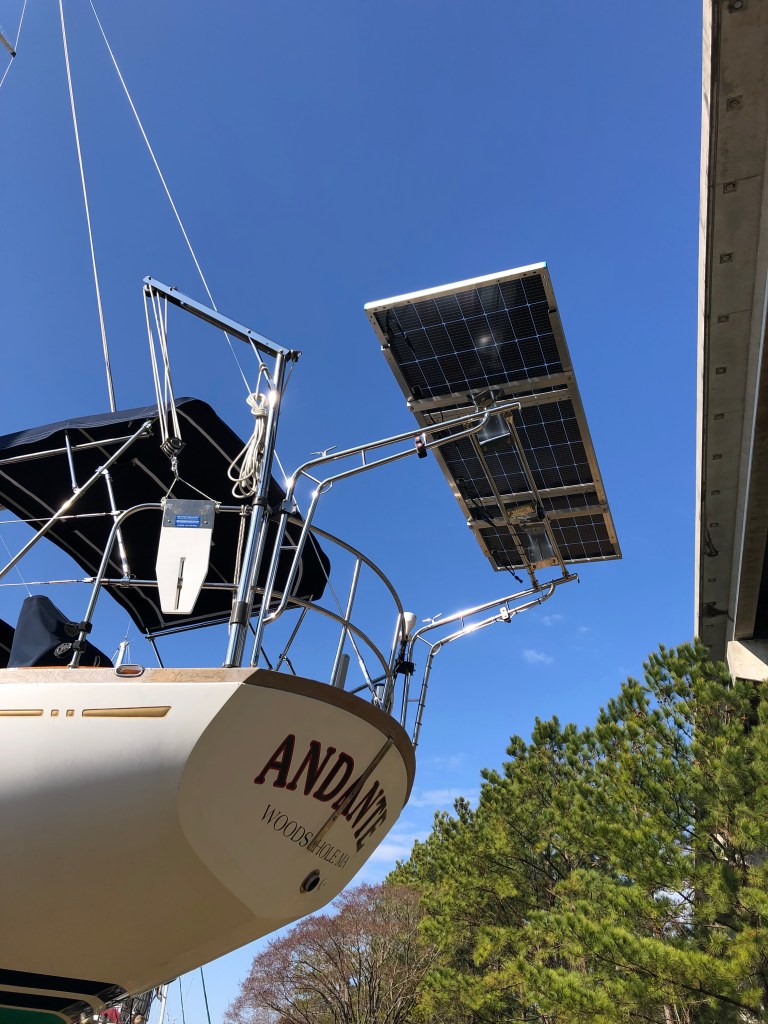
The list of jobs started out long and kept growing all winter. But progress was made. A new bimini was designed and sewn. A new set of solar panels was installed above the dinghy davits. Several new seacocks and associated plumbing were installed to service two new bilge pumps. And of course lots of routine maintenance: Hull scraped and painted; anchor chain end-for-ended and marks repainted; new anodes on the hull and prop; upgrades to various bits of running rigging. And as much varnishing of exterior woodwork as time and weather would allow.

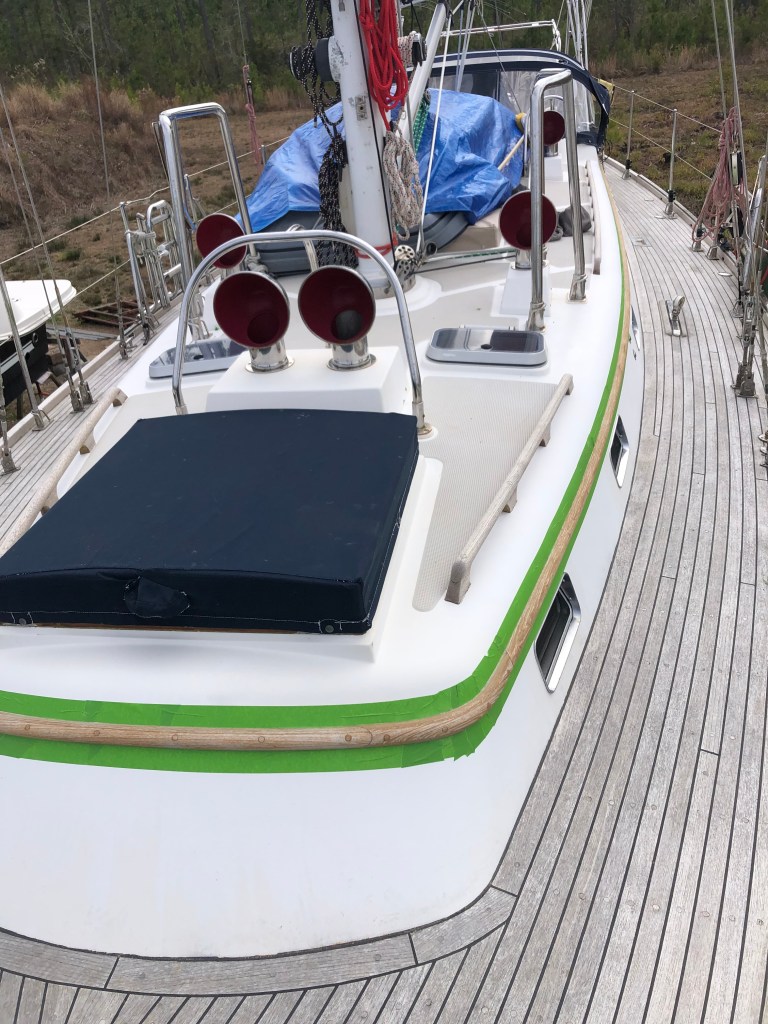
It took nearly 3 years to get all the old varnish removed. Applying the first new coat to the eyebrow was surprisingly satisfying. We’ll see how long that feeling lasts.

There was only one real surprise that required some extra effort. At some point during the trip south one of the four heavy steel engine mounts — the one that also supports our refrigeration compressor — cracked and broke. Once I was able to jack up the engine and remove the mount it was a simple matter for the skilled folks at Bock Marine to repair it for us, welding on additional stiffeners so this will never happen again.

Shiny and extra-strong engine mount after repair
It took a couple of months to design fabricate the aluminum framework for our new solar panels. The array consists of three 115W bifacial panels. As solar arrays on sailboard go this is pretty small .
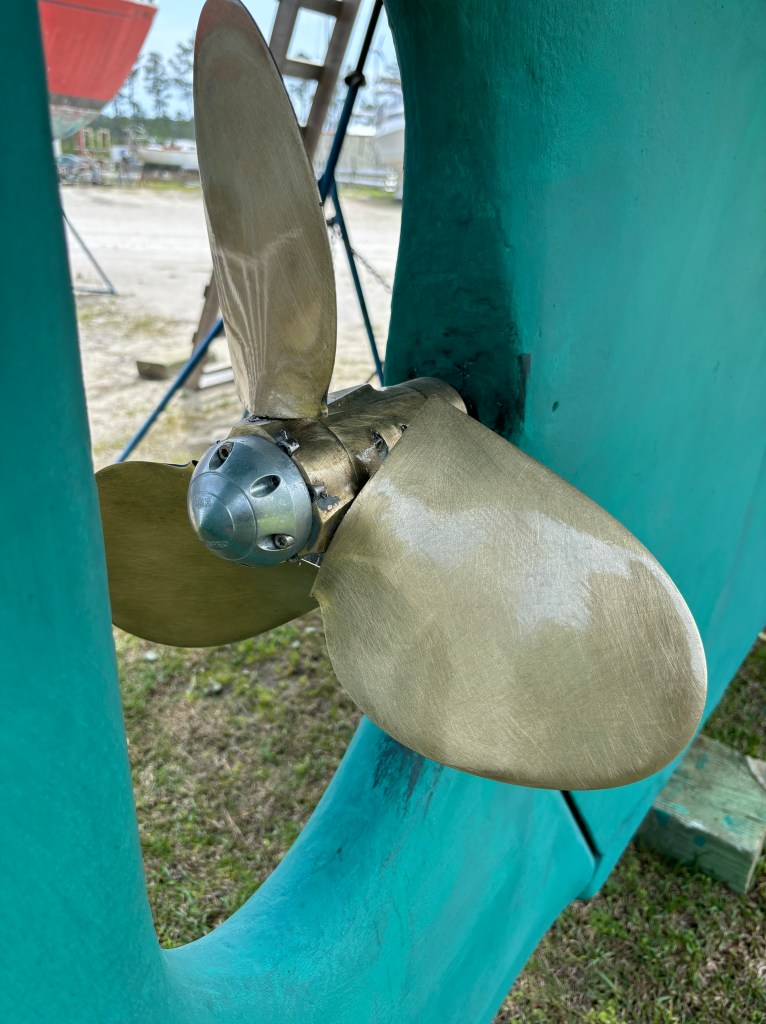
This year we tried a new and relatively inexpensive clear coat on the prop. It is supposed to be extremely hard and slippery so that barnacles can’t get a grip and should just slide right off. We’ll see about that.
Andante was back in the water in mid-April with fresh bottom paint.
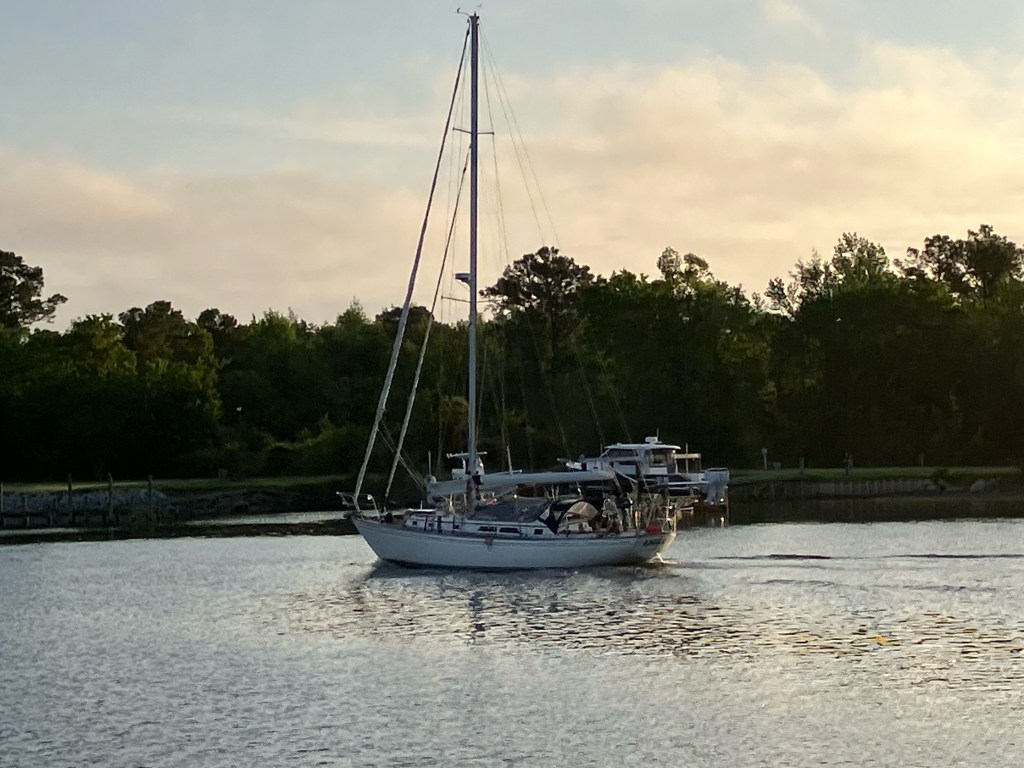
And by the third week of April we were underway towards home. This photo was taken by Kenny Bock from his house on Core Creek.

The trip home was short and all business. Persistent north winds precluded a direct shot from Beaufort to Cape Cod around Cape Hatteras. So we retraced our steps north along the ICW to Norfolk before jumping out into the Atlantic. With favorable winds we completed the remainder of the trip in three days with quick nap stops in Cape May and Sandy Hook.

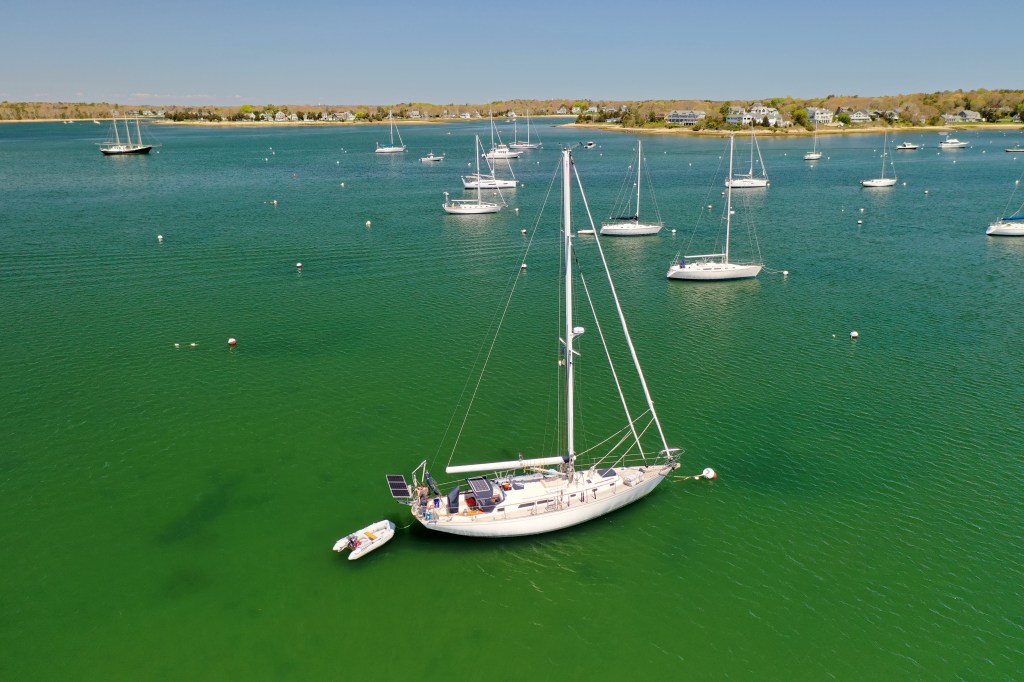
Andante back home on her mooring in Red Brook Harbor. The water is extremely green but clear in early May.